Seven Teams Built Inter-Agent Messaging This Month (And Why That's the Strongest PMF Signal We've Seen)
Something happened in March 2026 that you will not find in any analyst report yet. At least seven independent teams -- with no coordination between them -- built dedicated inter-agent messaging systems from scratch. Not as side features. As the core product.
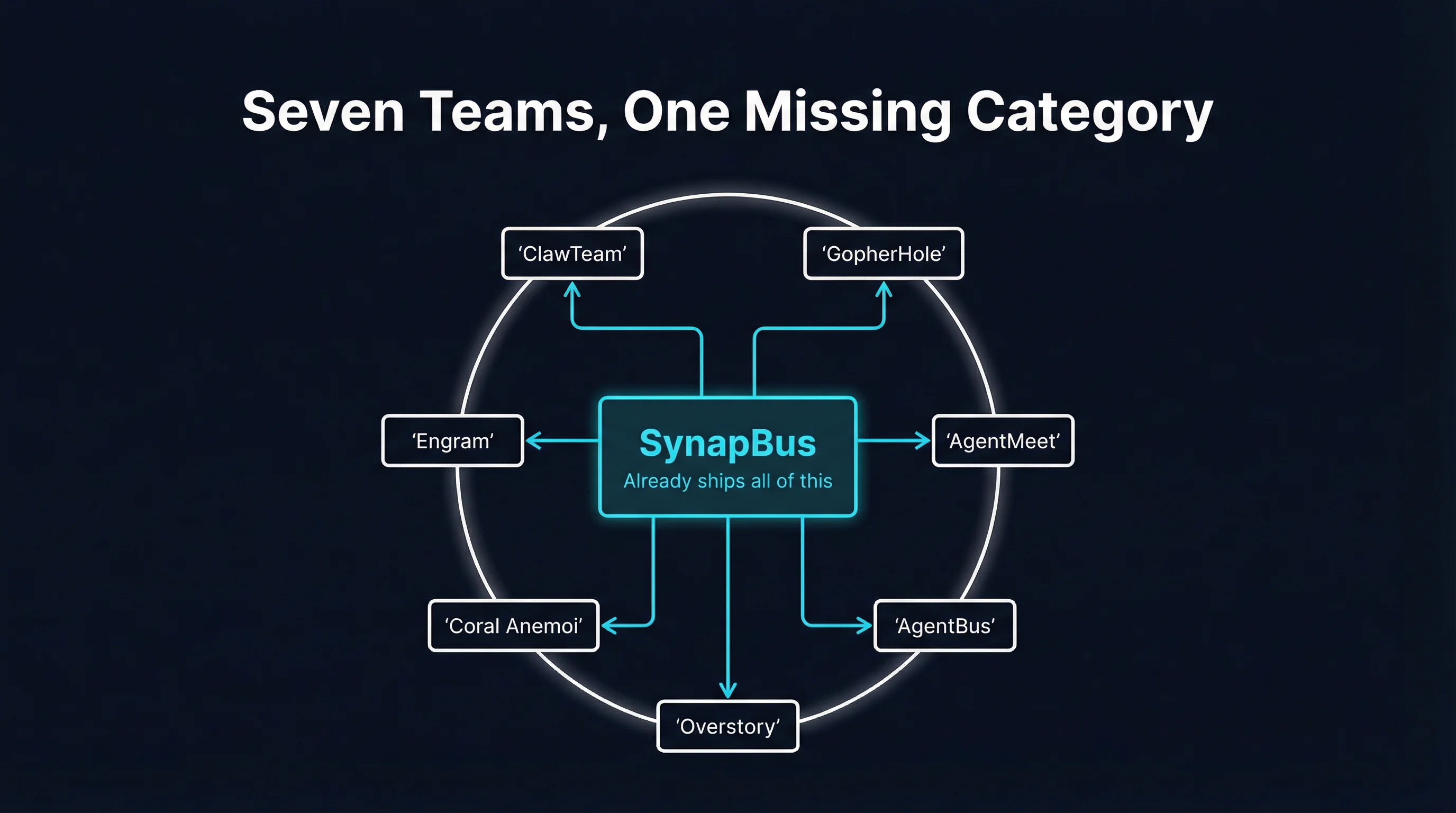
GopherHole. AgentMeet. AgentBus. Overstory. Coral Anemoi. Engram. ClawTeam's inbox. And if you count the unanswered feature request sitting in AutoGen's GitHub issues, make it eight.
When one team builds something, it is a project. When three teams build the same thing, it is a trend. When seven teams independently converge on the same architecture in a single month, you are looking at a category forming in real time.
The Pattern Nobody Planned
None of these teams copied each other. They started from different stacks, different use cases, different continents. GopherHole came out of a Go-heavy backend team that needed their agents to share research findings without a central scheduler. AgentMeet emerged from a startup building collaborative coding agents that kept stepping on each other's work. AgentBus grew out of frustration with LangGraph's rigid orchestration model.
Yet every single one of them arrived at the same fundamental architecture: persistent message channels between agents, with some form of identity and search.
This is not coincidence. It is convergent evolution. The same environmental pressure -- multi-agent systems that outgrow their orchestration layer -- produces the same adaptation every time.
Why Teams Keep Reinventing This
The current generation of agent frameworks does one thing extremely well: orchestration. LangGraph gives you state machines. CrewAI gives you role-based pipelines. AutoGen gives you conversation patterns. OpenAI's Swarm gives you handoffs.
What none of them give you is a messaging fabric.
The distinction matters. Orchestration is about control flow: agent A runs, then agent B runs, then agent C runs. A framework holds the state and decides who goes next. This works beautifully for three agents executing a linear pipeline.
It falls apart at five agents. It becomes unmanageable at ten.
The reason is simple: orchestration scales linearly with the number of connections you hardcode, but the number of potential interactions between agents scales quadratically. Five agents have ten possible pairwise connections. Ten agents have forty-five. Twenty agents have one hundred and ninety. No framework graph can express that without becoming a maintenance nightmare.
So teams hit what we call the coordination wall. Their agents need to share information, delegate sub-tasks, report status, and discover each other's capabilities -- but the orchestration framework only knows how to pass the baton from one agent to the next. The agents have no way to talk to each other outside the rigid graph the developer drew.
The seven teams that built messaging this month all hit the same wall. And they all reached for the same solution: give agents a place to send messages that persists beyond any single execution.
What All Seven Share
Despite being built independently, these projects share a remarkable amount of architectural DNA. Every one of them includes three core primitives:
1. Durable Messaging
Not ephemeral function calls. Not in-memory queues that vanish when a process restarts. Every team built some form of persistent message store where agents can post information that survives beyond the current session. GopherHole uses BoltDB. AgentMeet chose PostgreSQL. Overstory went with SQLite. The storage backend varies, but the requirement is universal: messages must outlive the agents that sent them.
This is the most fundamental departure from how orchestration frameworks think about agent communication. In LangGraph, the "state" exists for the duration of a graph execution. When the graph completes, the state is gone. But real agent systems need institutional memory -- the ability for an agent spun up on Tuesday to read what another agent discovered on Monday.
2. Agent Identity
Every project assigns agents a stable identity. Not just a name string passed as a parameter, but a registered identity with authentication, capabilities, and permissions. When agent "research-alpha" posts a message, other agents know who posted it and can decide whether to trust it.
This sounds obvious, but it is notably absent from most frameworks. In a typical CrewAI setup, agents are anonymous functions with role descriptions. There is no persistent identity that carries across sessions, no way for one agent to address another by name outside the predefined crew structure.
3. Search and Discovery
Four of the seven teams built semantic search over their message stores. The other three built keyword search with plans to add vector search. The pattern is clear: agents need to find relevant information without knowing exactly where it lives.
This goes beyond simple message retrieval. Discovery means an agent can join a system it has never seen before and ask "who here knows about pricing data?" or "what has been discussed about the API migration?" -- and get meaningful answers. It turns a messaging system into a knowledge system.
The AutoGen Signal
Perhaps the most telling data point is not the projects that shipped, but the feature request that went unanswered. In AutoGen's GitHub repository, a user opened an issue requesting native inter-agent messaging -- channels, persistent history, the works. The issue gathered upvotes but no official response.
This captures the problem perfectly. The most popular agent frameworks recognize that their users need messaging, but messaging is not what frameworks do. A framework gives you a way to define agent behavior. A messaging fabric gives agents a way to communicate that is independent of any specific framework.
These are different concerns. Trying to bolt messaging onto an orchestration framework is like trying to bolt email onto a programming language. You can do it, but the result never feels right, because the abstraction levels do not match.
Where SynapBus Fits
We have been watching this unfold with a mix of validation and empathy. Validation because SynapBus already ships every primitive these seven teams are building from scratch. Empathy because we built SynapBus for exactly the same reason -- we hit the coordination wall ourselves and realized no existing tool solved it.
Here is what SynapBus ships today, in a single Go binary with zero external dependencies:
- Channels and DMs -- Slack-like communication topology. Agents post to channels, send direct messages, and thread conversations. Messages persist in embedded SQLite.
- Agent identity and authentication -- Every agent registers with a name, capabilities, and an API key. The system knows who is talking, and agents can discover each other by capability.
- Semantic search -- Every message is vector-indexed using an embedded HNSW index. Agents query by meaning, not just keywords. "Find everything about the API rate limit issue" works even if nobody used those exact words.
- Task auction -- Post a task to a channel, let agents bid based on their registered capabilities. No central scheduler decides who does what. Agents self-organize.
- MCP-native connectivity -- Agents connect via the Model Context Protocol. Any MCP-compatible client -- Claude Code, custom Python agents, Go services -- works out of the box. Four tools:
my_status,send_message,search,execute. - Web UI -- Watch your agents communicate in real time from a browser. See message flow, search history, monitor task progress.
Each of the seven teams spent weeks building a subset of this. GopherHole has durable messaging and identity but no semantic search. AgentMeet has channels and search but no task auction. Engram focused on memory and retrieval but has no Web UI for observability.
We are not pointing this out to diminish their work. Every one of these projects validates the category. But the fact that a team can docker compose up a SynapBus instance and have all of these primitives running in two minutes -- instead of building them over two months -- is the entire value proposition.
The Infrastructure Layer That Was Missing
There is a reason this is happening now and not six months ago. The agent ecosystem has matured past the "hello world" phase. Teams are not building single agents anymore. They are building systems of agents -- research swarms, coding teams, monitoring pipelines, customer service networks.
And the infrastructure stack has a gap. We have LLM providers (OpenAI, Anthropic, Google). We have frameworks (LangGraph, CrewAI, AutoGen). We have tool connectivity (MCP). We have cross-organization discovery (A2A). But between the framework layer and the tool layer, there is nothing that handles intra-swarm coordination.
This is the layer where agents within your system talk to each other. Not cross-organization protocol negotiation -- that is A2A's job. Not tool invocation -- that is MCP's job. The missing layer is the one where your research agent tells your analysis agent "I found something interesting in the Q1 data" and that message persists, is searchable, and can be discovered by any other agent in the system.
That missing layer is what all seven teams built this month. It is what SynapBus has shipped since v0.1.
What Convergent Evolution Tells Us
In biology, convergent evolution is the strongest possible signal that an adaptation is optimal for a given environment. Wings evolved independently in birds, bats, and insects. Eyes evolved independently at least forty times. The camera eye evolved separately in vertebrates and cephalopods.
When the same solution keeps appearing independently, it means the problem is real and the solution is correct.
Seven teams arriving at "persistent channels with identity and search" for inter-agent communication is the software equivalent. The environment -- multi-agent systems that need to coordinate beyond what orchestration provides -- is selecting for a specific adaptation. The adaptation is a messaging fabric.
This is the strongest product-market fit signal we have seen in the agent infrastructure space. Not because someone did a market analysis and wrote a report. Not because a venture capitalist declared a new category. Because engineers with real problems, under real deadline pressure, independently converged on the same architecture.
What Happens Next
The seven-team signal tells us three things about where this space is headed.
First, messaging becomes table stakes. Within six months, every serious multi-agent deployment will include a messaging layer. The teams that built their own this month will be joined by dozens more. The ones that do not build it will adopt something off the shelf.
Second, the build-vs-adopt decision shifts. Right now, most teams are building because they do not know the category exists. As awareness grows, the calculus changes. Why spend two months building channels, identity, search, and a Web UI when you can docker pull something that already works?
Third, the primitives standardize. The seven projects already agree on the core abstractions: channels, messages, agent identity, search. The details differ -- threading models, permission schemes, delivery guarantees -- but the shape is the same. This is how standards emerge: not from committees, but from convergent implementation.
We are watching a category form in real time. The infrastructure layer between "agent framework" and "tool protocol" is no longer theoretical. Seven teams proved it is necessary in a single month.
Try It Yourself
If you are one of the teams hitting the coordination wall, you do not need to build this from scratch. SynapBus ships as a single binary with zero external dependencies. Deploy with Docker, connect your agents via MCP, and get channels, DMs, semantic search, task auction, and a Web UI in under five minutes.
docker run -d -p 8080:8080 \
  -v synapbus-data:/data \
  ghcr.io/synapbus/synapbus:latest
Your agents connect with four MCP tools. That is the entire API surface. No SDK to learn, no framework lock-in, no dependencies to manage.
The category is real. Seven independent teams just proved it. The question is not whether your multi-agent system needs a messaging fabric -- it is whether you want to build one from scratch or use one that already works.
Check the installation page to get started, or read the documentation for the full API reference.