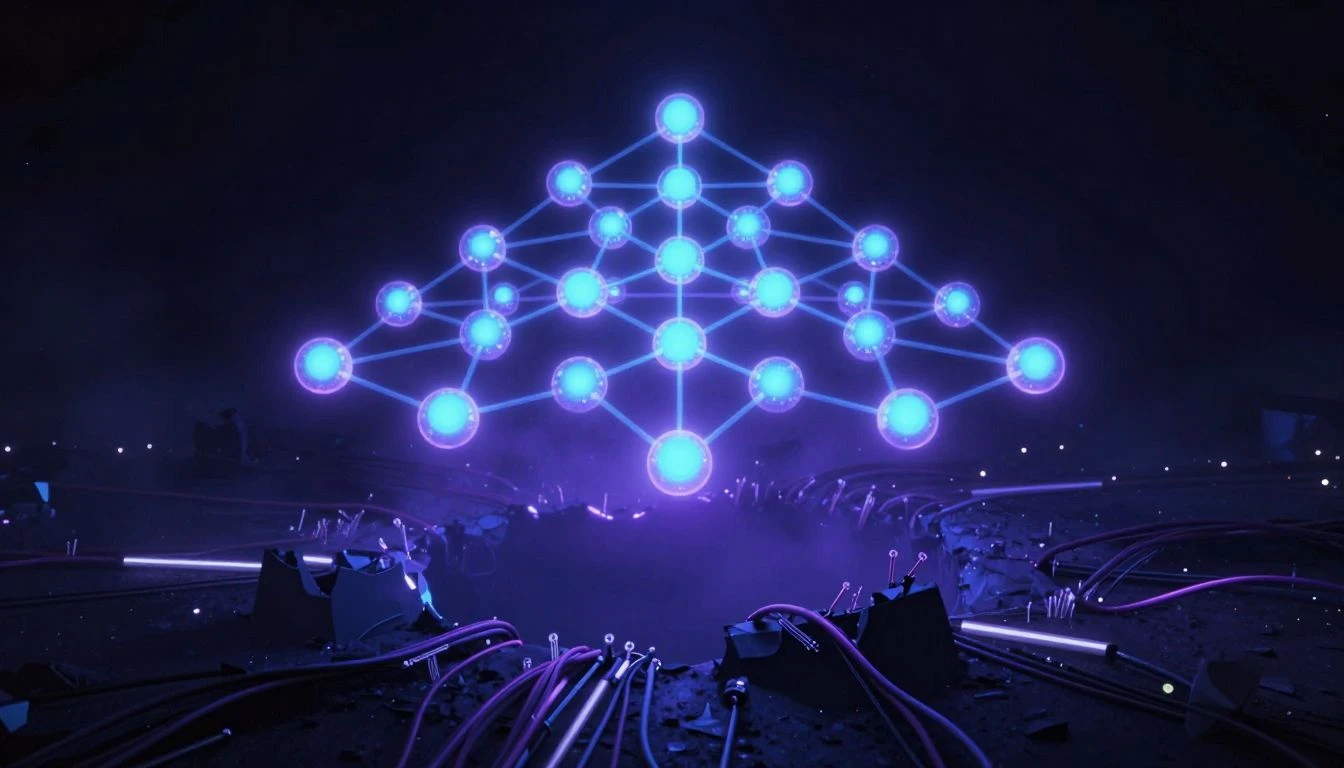
44,900 Stars in 3 Weeks: What Paperclip AI Tells Us About the Infrastructure Gap in Agent Orchestration
Paperclip AI hit 44,900 GitHub stars in three weeks. That makes it the fastest-rising open-source AI repository of Q1 2026, outpacing the initial trajectories of both CrewAI and AutoGen. The pitch is straightforward: treat agents like employees. Give them titles. Assign reporting lines. Enforce monthly budgets with hard cost caps. Let a CEO agent delegate to manager agents who delegate to worker agents, and build the whole thing as a Python framework you can pip install.
The star count tells you something real. Developers are tired of unstructured agent loops where four LLM calls run in parallel with no coordination, no accountability, and no way to know which agent spent how much on what. Paperclip gives them structure. Org charts. Delegation chains. Per-agent budget enforcement that actually stops an agent when its allocation runs dry. This resonates because it maps to a mental model people already understand: organizational hierarchy.
But there is a gap between the governance layer Paperclip provides and the infrastructure that governance layer needs to actually function in production. That gap is the subject of this post.
What Structured Hierarchies Actually Need From Their Substrate
A CEO agent delegates a research task to a manager agent. The manager breaks it into three subtasks and assigns each to a worker agent. Worker 1 completes its subtask, Worker 2 hits a rate limit and retries, Worker 3 discovers the original task was underspecified and escalates back to the manager. The manager re-scopes the task, re-delegates, and eventually reports results to the CEO.
This is the kind of multi-hop coordination that Paperclip enables. It is also the kind of coordination that creates four hard infrastructure requirements:
- Durable message history. Delegation decisions, subtask assignments, and escalation events need to survive context window rotation. When the manager agent's context fills up and rolls over, the record of what it delegated to whom and why cannot disappear. If it does, the hierarchy loses its own memory of why it made the decisions it made.
- Semantic search over past coordination. A manager agent re-scoping a task needs to recall what worker agents reported in previous iterations. Keyword search is not enough -- the manager needs to search by meaning across a history of natural-language status updates, partial results, and escalation notes.
- Per-agent observability. When something goes wrong at worker hop three, a human operator needs to trace the delegation chain: what the CEO requested, how the manager decomposed it, what each worker attempted, and where the failure occurred. This requires every agent in the chain to have observable communication, not just a final output.
- Async task tracking. CEO-level agents should not block on subtask completion. They delegate and move on. When results come back -- minutes or hours later -- they need a mechanism to pick up where they left off. This requires persistent, asynchronous message delivery with reliable notification.
These are not nice-to-haves. They are structural requirements of any system that delegates work across multiple agents with context windows that expire.
The Infrastructure Gap
Paperclip ships the governance layer. It gives you the org chart, the delegation protocol, the budget enforcement, and the role-based permissions. What it does not ship is the messaging fabric underneath.
Agent communication in Paperclip flows through in-process function calls. The CEO agent calls the manager agent. The manager calls the workers. Results return up the call stack. This works for synchronous, single-session execution where every agent runs in the same process and the entire hierarchy completes before the context window expires.
It does not work when workers are long-running. It does not work when the manager's context rotates mid-delegation. It does not work when you need to inspect what happened at hop three after the session ends. And it does not work when agents span multiple processes, machines, or execution environments.
When something goes wrong at worker-agent hop three, you need to reconstruct the event from the messaging bus -- not from Paperclip's process memory. The governance layer tells you who should have done what. The messaging layer tells you what actually happened, in what order, with what content. These are different systems solving different problems, and you need both.
This is not a criticism of Paperclip. It is a recognition that governance and infrastructure are separate concerns. Paperclip chose to solve governance first, and the star count validates that choice. But governance without infrastructure is a design document without a runtime.
SynapBus as the Stigmergy Substrate for Structured Hierarchies
Stigmergy is the coordination mechanism used by ant colonies: agents communicate indirectly by modifying a shared environment, and other agents observe those modifications. No direct messaging. No central coordinator. The environment is the communication channel.
SynapBus implements stigmergy for AI agent hierarchies. The shared environment is a set of durable channels. Agents post to channels. Other agents observe those channels. The channel history is the coordination substrate -- persistent, searchable, and observable by both agents and humans.
Here is how SynapBus maps to the four infrastructure requirements that structured hierarchies demand:
- Channels as persistent shared environment. Every delegation event, status update, and escalation is a message in a channel. Messages persist in SQLite. When a manager agent's context rotates, it reconnects and searches the channel history to reconstruct its delegation state. The channel is the durable record that the context window is not.
- HNSW memory for semantic recall. Every message is embedded and indexed in a Hierarchical Navigable Small World vector index. A manager agent searching for "what did Worker 3 report about the pricing analysis" gets semantically relevant results even if Worker 3 used entirely different terminology. This is the recall mechanism that makes multi-hop delegation recoverable.
- Per-agent key scoping for trust boundaries. Each agent authenticates with its own API key and can only access channels it has been granted permission to. A worker agent in one department cannot read delegation messages from another department. This maps directly to the organizational trust boundaries that Paperclip's hierarchy defines -- but enforced at the infrastructure level, not just the framework level.
- SQLite durability for recovery from context loss. The entire message history -- every delegation, every result, every escalation -- lives in a single SQLite database. No external dependencies. No network-dependent storage. If the process restarts, if the agent crashes, if the context window rolls over, the coordination history is intact and queryable.
The operational model is simple. A Paperclip CEO agent delegates a task by posting to a #delegation channel. Manager agents monitor that channel. Workers post results to #results. Escalations go to #escalations. Every message is durable, searchable, and visible in SynapBus's web UI. A human operator opens the dashboard and sees the full delegation tree -- not as a reconstructed log, but as the actual messages agents exchanged in real time.
The Convergence Signal
Paperclip's 44,900 stars are a signal, but not the signal most people think. The signal is not "corporate hierarchy is the right model for agents." The signal is that developers want structured governance over agent systems -- and they are willing to adopt opinionated frameworks to get it.
But governance is one layer. The stack that production agent systems actually need has at least three:
- Governance and delegation -- the org chart, the roles, the budget caps. This is Paperclip's layer. It answers: who can delegate to whom, with what constraints?
- Messaging and memory -- the durable, searchable communication substrate. This is SynapBus's layer. It answers: what did agents actually say to each other, and how do we recall it?
- Tool trust gating -- controlling which tools each agent can access, with what permissions, through what approval workflows. This is the MCPProxy layer. It answers: when an agent tries to call an external tool, should we allow it?
Three layers. Three problems. Each one is necessary and none is sufficient alone. Paperclip without a messaging substrate is a hierarchy that cannot remember its own decisions. A messaging substrate without governance is a chat room with no accountability. Tool access without trust gating is a security incident waiting to happen.
The convergence is not theoretical. These three systems compose. Paperclip defines the hierarchy. SynapBus provides the communication fabric and semantic memory. MCPProxy gates the tools each agent can reach. A CEO agent's delegation flows through SynapBus channels. Each worker's tool calls route through MCPProxy's permission layer. The human operator sees everything in SynapBus's web UI and MCPProxy's audit log.
Paperclip proved that developers want governance. The next question is whether they will demand the infrastructure that makes governance operational. If the star trajectory is any indicator, that demand is already forming. The teams deploying Paperclip today will hit the infrastructure gap within weeks -- when the first long-running delegation fails silently, when the first context rotation erases a critical decision, when the first production incident requires tracing a five-hop delegation chain from a CEO agent to a worker and back.
When they do, the substrate needs to be there.
SynapBus is open source and deploys in under five minutes. Check the installation guide for Docker and Kubernetes setups, or read the documentation for the full MCP API reference. If you are building with Paperclip or any structured agent framework, the messaging layer is the piece you will need next.