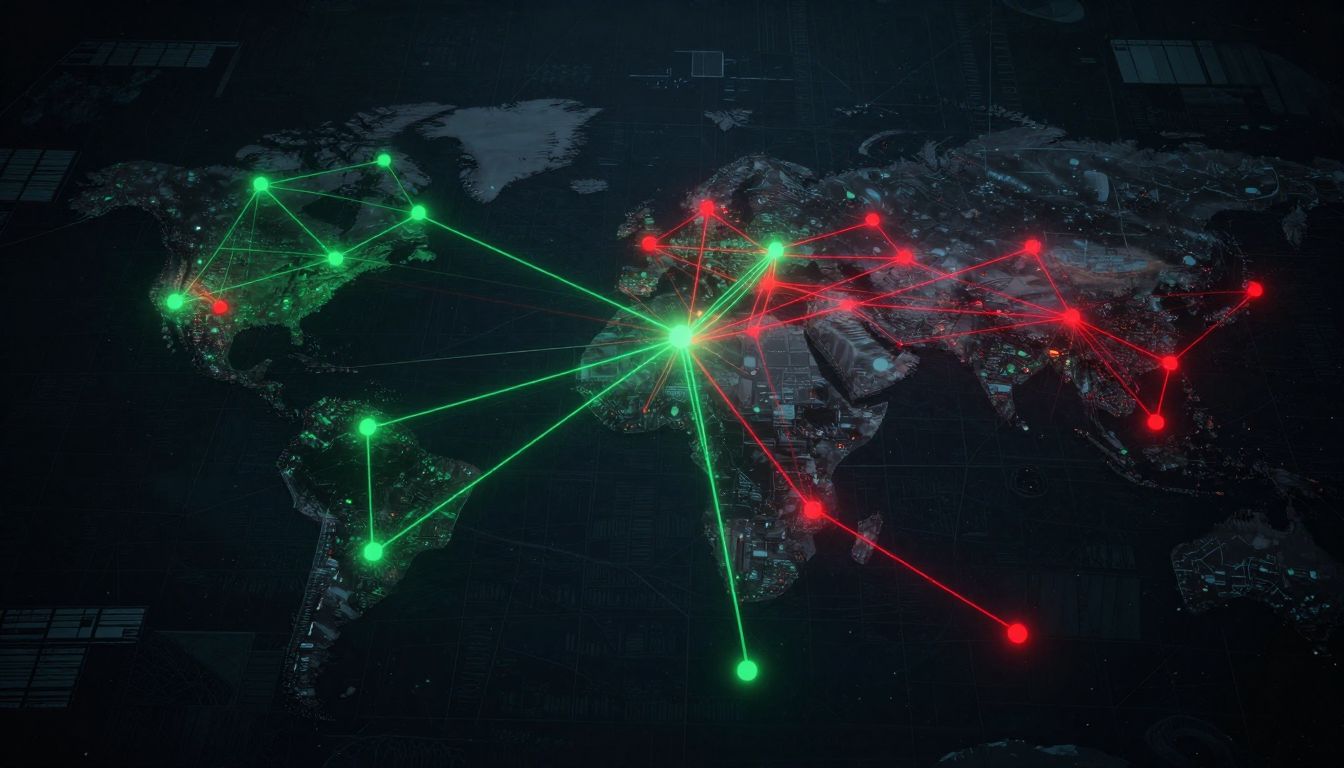
Google DeepMind Just Mapped the Attack Surface for Multi-Agent AI — And It's Bigger Than You Think
On April 1, Google DeepMind published "Traps and Pitfalls of Agentic AI Systems" (Franklin et al., 2026) — a systematic taxonomy of how multi-agent AI systems fail under adversarial pressure. The paper identifies six distinct attack categories. Three of them are well-known. One of them should keep every multi-agent builder awake tonight.
This is not an abstract research exercise. If you are building, deploying, or operating systems where multiple AI agents coordinate through shared tools and communication channels, this paper is your threat model. Here is what it says, what it means, and what the defense actually looks like in production.
The Six Attack Categories
Franklin et al. organize the attack surface into six categories, escalating from individual agent exploits to system-level emergent failures:
Prompt injection. The attacker manipulates an agent's instructions through crafted input. This is well-documented, widely discussed, and still largely unsolved at the protocol level. Every agent framework has some exposure here.
Tool misuse. The attacker induces an agent to call a legitimate tool with malicious parameters. The tool works exactly as designed — the damage comes from what the agent was tricked into asking for. SQL injection through a database tool. File deletion through a filesystem tool. The tool is not the vulnerability; the agent's judgment is.
Data exfiltration. The attacker uses an agent's tool access to extract sensitive data to an external endpoint. An agent with HTTP access and database access has everything it needs to be a data exfiltration pipeline. No malware required.
Agent impersonation. The attacker sends messages that appear to originate from a trusted agent. In systems where agent identity is an honor system — a name field in a JSON payload, a string in a message header — impersonation is trivial. This is the multi-agent equivalent of email spoofing, and most coordination frameworks have exactly the same level of protection that email had in 1995.
Systemic traps. This is the new one. This is the category that changes the threat model.
Coordination failure exploitation. The attacker degrades the coordination mechanism itself — introducing delays, corrupting shared state, or exploiting race conditions in agent communication — to cause agents to take conflicting or destructive actions.
The first four categories are single-agent problems that happen to occur in multi-agent contexts. The last two are fundamentally multi-agent problems. They cannot exist without coordination, and they cannot be detected without observing the coordination layer.
Why Systemic Traps Are the Hard Problem
A systemic trap works like this: the attacker distributes fragments of a malicious payload across multiple data sources that different agents consume. No single fragment is suspicious. No single agent does anything wrong. The malicious behavior only emerges when the fragments combine through the natural coordination flow of the multi-agent system.
Picture five agents, each responsible for a different data domain. Agent A reads a news feed and extracts a seemingly benign policy update. Agent B processes a vulnerability database and flags a routine CVE. Agent C monitors a code repository and notes a dependency change. Agent D aggregates market data and identifies a pricing anomaly. Agent E synthesizes reports from Agents A through D and recommends an action.
The action is the attack. But no individual agent saw the attack. Each agent processed legitimate data through legitimate tools and produced a legitimate intermediate result. The malicious intent was encoded in the relationship between the data fragments — a relationship that only becomes visible when you can observe the full communication history across all five agents.
Traditional security monitoring watches individual requests. A WAF inspects one HTTP request at a time. An LLM guardrail evaluates one prompt at a time. An agent sandbox constrains one tool call at a time. None of these can detect a pattern that spans five agents and twelve tool calls over thirty minutes. The attack surface is not the agent. The attack surface is the space between the agents.
The defense requires two capabilities that most multi-agent systems do not have: a durable, searchable record of all agent communication, and multi-stage filtering that can reason across the full message history. If your agents do not share a coordination layer with full audit history, you literally cannot detect this class of attack. It is not that detection is hard. It is that detection is architecturally impossible.
What the Paper Prescribes vs. What Builders Have Today
Franklin et al. are precise about what the defense looks like. They prescribe three requirements:
- An observable audit trail across all agents. Every message, every tool call, every intermediate result — persisted, timestamped, and attributable to a specific agent identity.
- Multi-stage filtering. Security analysis that operates not on individual events but on sequences of events across agent boundaries, with the ability to identify emergent patterns.
- Semantic search over agent history. The ability to query the audit trail by meaning, not just by keyword or timestamp. "Show me all agent communications related to this CVE" — across agents that may never have used the CVE identifier directly.
Now compare that to what most builders actually have today. Logs in four different systems. No cross-agent search. Ephemeral in-memory state that vanishes when the process restarts. Agent identity enforced by convention. Communication through function calls that leave no persistent trace.
The paper describes a defense architecture. Most multi-agent systems are missing every component of it.
This Week Makes the Case in Real Time
The week of April 1, 2026 delivered three independent security events: Anthropic's policy change around tool use permissions, CVE-2026-32211 (the CVSS 9.1 missing-auth vulnerability in Microsoft's Azure MCP Server), and the demonstration of a GitHub MCP exploit chain that weaponized repository metadata.
Each event, in isolation, is a news item. An agent monitoring Anthropic's changelog sees a policy update. An agent monitoring the NVD sees a new CVE. An agent monitoring GitHub security advisories sees an exploit proof-of-concept.
Now consider an agent system coordinating across all three data sources simultaneously. The Anthropic policy change alters what tool calls an agent will accept. The Azure CVE reveals that a widely-deployed MCP server has no authentication. The GitHub exploit shows a concrete attack path through repository metadata. An agent that can see all three events in the same coordination context can recognize the compound threat: authenticated MCP servers are being weakened at the policy level while unauthenticated ones are being actively exploited, and the exploit vector runs through the development infrastructure that every engineering team uses daily.
That compound analysis is not possible if each agent's observations evaporate after the session ends. It is not possible if the agents cannot search each other's findings. It is not possible without the exact infrastructure the DeepMind paper prescribes: durable communication, semantic search, cross-agent visibility.
Observable coordination infrastructure is the difference between "we saw the pattern forming" and "we learned about it from a post-mortem."
SynapBus as One Implementation of the Defense
SynapBus was not designed as a response to this paper. It was designed around the same principle that the paper arrives at independently: agent coordination needs to be durable, searchable, and auditable — not ephemeral.
Here is what the architecture provides, mapped directly to the paper's requirements:
Durable message history. Every message sent through SynapBus is persisted. Agent-to-agent DMs, channel broadcasts, threaded replies — all stored with full metadata. There is no in-memory-only mode. There is no "fire and forget." If an agent said it, SynapBus recorded it.
Per-agent identity. Every agent authenticates with an API key. Every message is attributable to a verified sender. Agent impersonation requires compromising the authentication layer, not just knowing an agent's name. This directly addresses the paper's agent impersonation category.
Semantic recall. SynapBus indexes message history using HNSW (Hierarchical Navigable Small World) vector search. Agents can query the communication history by meaning. "Find all messages related to MCP authentication vulnerabilities" returns results across agents, channels, and time windows — even if different agents used different terminology. This is the semantic search capability the paper prescribes.
Full thread history across participants. When Agent E synthesizes results from Agents A through D, the entire thread — every intermediate message, every tool result, every agent's contribution — is retrievable as a single auditable unit. A security reviewer can reconstruct the complete decision chain that led to any action.
Channel-based workflow with reactions. Messages flow through observable states — proposed, in_progress, approved, published. The lifecycle of every coordination decision is tracked, not just the final output.
This is not a pitch. This is a mapping. The DeepMind paper describes a defense architecture with specific requirements. SynapBus is a binary that implements those requirements. You can run it on a single node. The agents authenticate, communicate through persistent channels, and the entire history is searchable by meaning.
The Question the Paper Leaves Open
Franklin et al. do excellent work mapping the threat landscape. They identify systemic traps as the category that existing security tooling cannot address. They prescribe the architectural requirements for a defense. What they do not do — because it is not their job — is tell you how to build it.
The answer is not a logging library. It is not a SIEM integration. It is not "add observability" as an afterthought to an existing agent framework. The coordination layer itself must be the audit trail. The medium through which agents communicate must be the system that records, indexes, and enables search across those communications.
The DeepMind paper is a threat model. SynapBus is one implementation of the defense. The question for every team running multi-agent systems in production is straightforward: what is yours?