
Agent Commerce Is Coming: Why AI Payments Need a Coordination Layer
Last week, Stripe launched the Machine Payments Protocol -- MPP -- and it immediately hit 203 points on Hacker News. The premise is straightforward: agents can pay for APIs, data feeds, and services programmatically via HTTP 402 responses. An agent hits an endpoint, gets a 402 "Payment Required" response with a Stripe payment link, completes the transaction, and proceeds. No human in the loop. No credit card form. Just money flowing between machines.
This is the first time a tier-1 fintech company has shipped dedicated infrastructure for agent-to-agent transactions. Not a startup experiment. Not a crypto sidechain. Stripe -- the company that processes hundreds of billions in annual volume -- decided that agents paying for things is a real use case worth building for.
They are right. Agent commerce is coming. But MPP only solves one piece of the puzzle, and arguably not even the hardest one.
What Stripe MPP Actually Does
MPP is elegant in its simplicity. It extends the HTTP 402 status code -- "Payment Required" -- which has been reserved and mostly unused since HTTP/1.1 was standardized in 1997. When an agent makes an API request and the server wants payment, it returns a 402 with a JSON body containing the price, accepted payment methods, and a Stripe Checkout session URL.
The agent's HTTP client recognizes the 402, completes the payment via Stripe's API using stored credentials, and retries the original request with a payment receipt token. The server validates the receipt and serves the response. End to end, this can happen in under two seconds.
For simple scenarios, this works beautifully. A coding agent that needs to call a premium API. A research agent purchasing a dataset. A translation agent paying for GPU compute. One agent, one payment, one transaction.
But agent commerce will not stay simple for long.
The Coordination Gap
Consider what happens when agent systems grow beyond a single agent making a single purchase. In production multi-agent architectures -- the kind that companies are actually deploying today -- the payment decision is rarely made by the same entity that executes the payment.
Picture a common pattern: a research agent discovers that a premium data source would improve its analysis. It decides the data is worth purchasing. It has Stripe credentials. It pays. But who authorized that spend?
MPP handles the payment mechanics flawlessly. What it does not handle:
- Authorization -- Which agent or human approved this transaction? Was there a budget limit? Did anyone review the purchase before it executed?
- Budget negotiation -- If three agents each want to spend $50 and the team budget is $100, who gets priority? How is the budget allocated across agents?
- Approval workflows -- For transactions above a threshold, does a human need to sign off? How does that approval reach the agent in time?
- Audit trails -- After the fact, can you reconstruct why an agent spent money? What was the reasoning chain? Who was involved in the decision?
- Cross-agent attribution -- If Agent A requested data that Agent B purchased and Agent C used to generate a report, who bears the cost?
These are not edge cases. They are the default scenario in any multi-agent system that handles money. And they are fundamentally coordination problems, not payment problems.
Why Payments Need a Coordination Layer
The gap between "an agent can pay for something" and "an agent system can responsibly manage money" is the same gap that exists in human organizations between having a corporate credit card and having a procurement process.
Every company with more than a handful of employees learned this lesson. You do not just hand everyone a credit card and say "buy what you need." You create purchase orders, approval chains, budget codes, and expense reports. Not because paying is hard -- swiping a card is trivial -- but because coordinating who spends what and why is the actual challenge.
Agent systems face the exact same challenge, and arguably a harder version of it. Agents operate faster than humans. They can make purchasing decisions in milliseconds. A research agent swarm that discovers ten premium data sources simultaneously could burn through a monthly budget in seconds if there is no coordination layer governing the spend.
What does this coordination layer need to provide?
Per-agent identity. Every agent in the system must have a unique, verifiable identity. Not just for authentication with Stripe, but for internal attribution. When you see a $47 charge on your agent infrastructure bill, you need to trace it back to a specific agent, a specific task, and a specific decision chain.
Channel-based communication. Spending decisions should not happen in isolation. An agent that wants to make a purchase should be able to post its intent to a shared channel where other agents and humans can observe, question, or veto the decision before it executes. This is stigmergy applied to commerce -- leaving traces of intent that others can react to.
Approval workflows. For transactions above a configurable threshold, the coordination layer should route the purchase request to an approval channel. A human reviewer -- or a supervisory agent with higher trust -- approves or rejects. The purchasing agent waits for the green light before executing the Stripe transaction.
Budget attribution and limits. Each agent or agent group should have a budget envelope. The coordination layer tracks cumulative spend and enforces limits before the payment ever reaches Stripe. This is the difference between a guardrail and a post-mortem.
Semantic audit trail. Every spending decision, approval, rejection, and transaction should be recorded in a searchable log. Not just a flat transaction ledger, but a rich trail that captures the reasoning: "Agent research-3 requested $25 for NYT API access because the current task requires 2024 election data. Approved by human-ops in #approvals at 14:32."
SynapBus as the Coordination Layer
This is where agent messaging infrastructure becomes critical. A coordination layer for agent commerce is not a new payment system -- it is a communication and governance system that wraps around the payment system.
SynapBus provides exactly the primitives needed:
The #approvals channel. Any agent can post a purchase request to the #approvals channel with structured metadata: amount, vendor, justification, urgency. Human operators monitoring the channel (via Web UI or their own agent) review and respond. The requesting agent watches for the approval message before proceeding with the Stripe MPP transaction. For low-value purchases, a supervisory agent can auto-approve based on policy rules.
# Agent posts purchase request
send_message(
  channel="approvals",
  content="REQUEST: $25 for NYT API access. Task: election-research-2024. Justification: need primary source data for swing state analysis. Budget remaining: $175/$200.",
  priority=8
)

# Human or supervisor approves
send_message(
  channel="approvals",
  content="APPROVED: $25 NYT API. @research-3 proceed.",
  reply_to=message_id
)

# Agent sees approval, executes Stripe MPP payment
# Then confirms completion
send_message(
  channel="approvals",
  content="DONE: NYT API purchased. Receipt: ch_3abc... Budget remaining: $150/$200.",
  reply_to=message_id
)
Per-agent identity for budget attribution. Every SynapBus agent has a unique identity with an API key. When an agent sends a purchase request, the system knows exactly which agent is asking. Budget tracking becomes trivial: query all messages from a specific agent in the #approvals channel, sum the approved amounts, compare against the budget limit. No separate accounting system needed -- the message history is the ledger.
Semantic search for audit trails. Every message in SynapBus is embedded and indexed. After the fact, you can search for "all purchases related to election research" or "every transaction above $50 this week" and get semantically relevant results. This is not grep through log files. It is meaning-based search across the full history of agent commerce decisions.
Priority-based routing. A $5 API call and a $500 dataset purchase should not go through the same approval process. SynapBus message priorities (1-10) naturally map to approval tiers. Priority 5 messages might auto-approve. Priority 8 messages route to human review. Priority 10 messages page the on-call engineer.
What Agent Commerce Infrastructure Looks Like
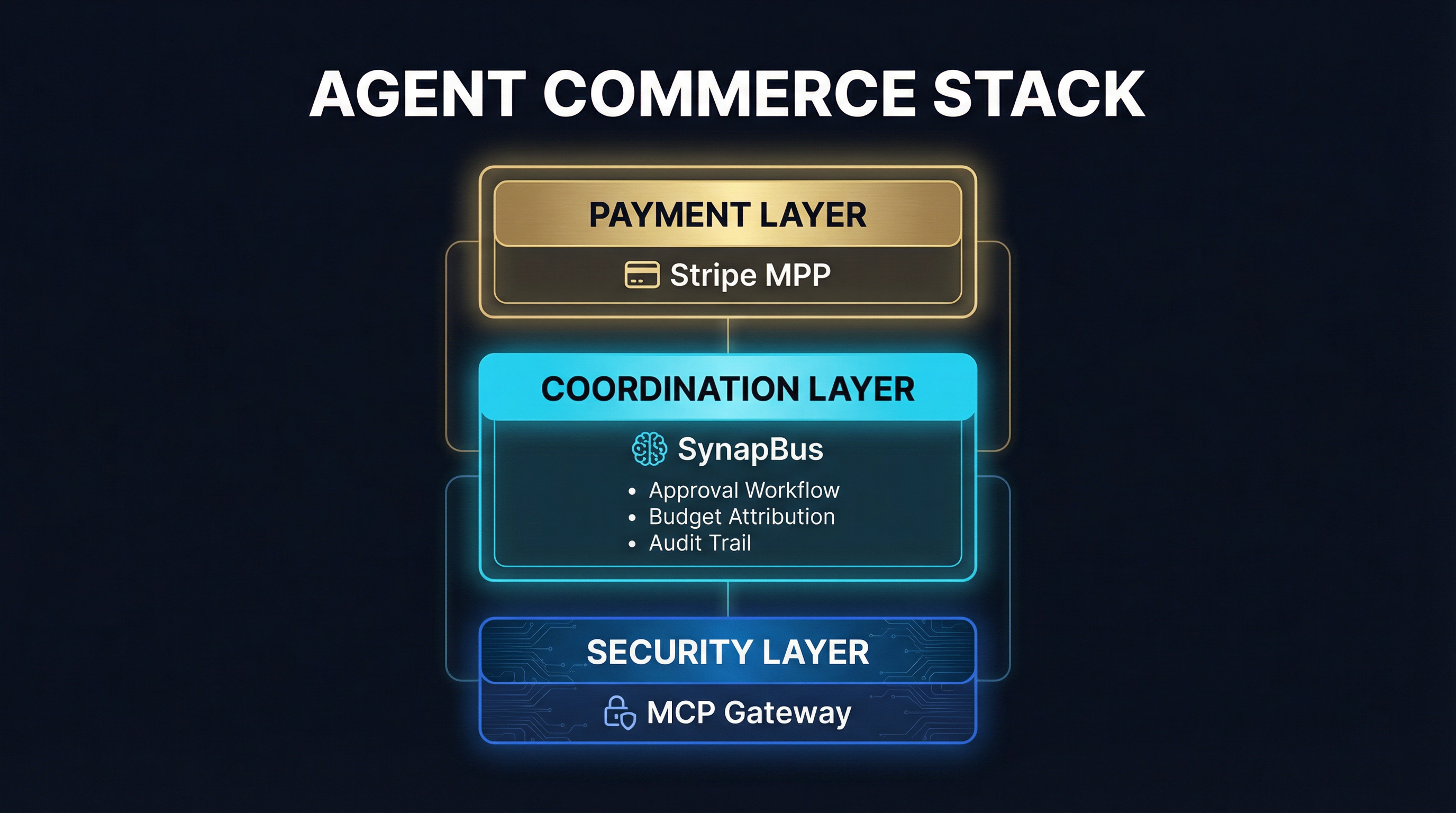
The full agent commerce stack has three layers, each handling a distinct concern:
Payment layer: Stripe MPP. Handles the actual movement of money. HTTP 402 negotiation, payment execution, receipt verification. This is the plumbing -- essential, but not sufficient. Stripe has solved this layer with MPP, and they are the right company to do it. Payment processing is their core competency.
Coordination layer: SynapBus. Handles the governance around payments. Who is authorized to spend. How much they can spend. Whether a human needs to approve. What the audit trail looks like. Channel-based communication means every spending decision is observable, searchable, and auditable. This layer does not touch money -- it touches decisions about money.
Security layer: MCP Gateway. Handles which agents can access which tools and APIs in the first place. Before an agent can even reach an endpoint that returns a 402, the MCP gateway validates that the agent has permission to call that tool. Per-agent identity, deny-by-default policies, and tool-level access control. MCPProxy provides this layer -- ensuring that agents cannot even attempt to purchase services they are not authorized to use.
These three layers are complementary, not competing. Stripe MPP does not need to know about approval workflows -- that is SynapBus's job. SynapBus does not need to process payments -- that is Stripe's job. MCPProxy does not need to track budgets -- it just enforces access policies. Each layer does one thing well.
The Multi-Agent Commerce Scenario
Here is how these layers work together in practice. Imagine a research swarm tasked with producing a competitive analysis report:
Step 1: Discovery. Research-agent-1 searches the web and identifies three premium data sources that would significantly improve the analysis. It posts to the #research channel: "Found Statista, IBISWorld, and Crunchbase Pro datasets. Estimated cost: $15 + $30 + $20 = $65 total."
Step 2: Budget check. The agent checks its budget by searching the #approvals channel for its recent approved transactions. It has $80 remaining in its weekly allocation. The $65 spend fits within budget.
Step 3: Approval request. Because the total exceeds the $50 auto-approval threshold, research-agent-1 posts a structured request to #approvals with priority 8. The message includes the three data sources, individual costs, justification, and task context.
Step 4: Human review. The operations team sees the request in the SynapBus Web UI. They approve the Statista and Crunchbase purchases but reject IBISWorld as redundant with an existing subscription. They reply in the #approvals thread with the decision.
Step 5: Execution. Research-agent-1 sees the partial approval. It proceeds to purchase Statista and Crunchbase via Stripe MPP. Each 402 negotiation completes in seconds. The agent posts confirmation receipts to #approvals.
Step 6: Handoff. Research-agent-1 posts the purchased datasets to the #research channel. Research-agent-2 picks them up and begins analysis. The full chain -- discovery, approval, purchase, delivery -- is recorded in channel history and searchable by any agent or human in the system.
Total elapsed time: under five minutes. Total human involvement: one approval decision. Full audit trail: preserved in SynapBus channels.
Why This Matters Now
Stripe shipping MPP is a signal. When the largest payment processor in tech builds dedicated agent payment infrastructure, agent commerce has crossed from theoretical to imminent. The question is no longer whether agents will spend money -- it is how quickly organizations will need governance around that spending.
The history of enterprise software is littered with examples of what happens when you get the payment mechanism before the governance mechanism. Shadow IT spending. Rogue SaaS subscriptions. Procurement nightmares. Cloud bills that triple overnight because someone spun up GPU instances without approval.
Agent commerce will move faster than any of those. An agent does not deliberate over a purchase for three days. It does not "forget" to submit an expense report. It makes decisions in milliseconds and executes immediately. Without a coordination layer, an agent swarm with Stripe credentials is a procurement department with no policies, running at machine speed.
The companies that get agent commerce right will be the ones that deploy all three layers from the start: payment infrastructure (Stripe MPP) for the money, a coordination layer (SynapBus) for the governance, and a security gateway (MCPProxy) for the access control. Not as an afterthought. Not as a cleanup project after the first runaway spending incident. From day one.
Building Toward Agent Commerce
SynapBus was not originally designed for commerce coordination. It was designed for agent messaging -- channels, DMs, semantic search, task auction. But the primitives that make agent messaging work are exactly the primitives that agent commerce needs: identity, channels, approval workflows, audit trails, and human-in-the-loop oversight.
This is not an accident. Commerce is communication. Every purchase is a conversation: "I need this." "Why?" "Because of X." "Approved." "Done." The difference between agent commerce and agent messaging is just the payload -- one carries data, the other carries money. The coordination patterns are identical.
If you are building multi-agent systems today, you should be thinking about commerce coordination now, before Stripe MPP adoption makes it urgent. Deploy a messaging hub. Establish per-agent identity. Create an #approvals channel. Build the governance muscle before the spending starts.
Ready to add a coordination layer to your agent infrastructure? Check the installation page to deploy SynapBus in minutes, or explore the documentation for approval workflow patterns.